
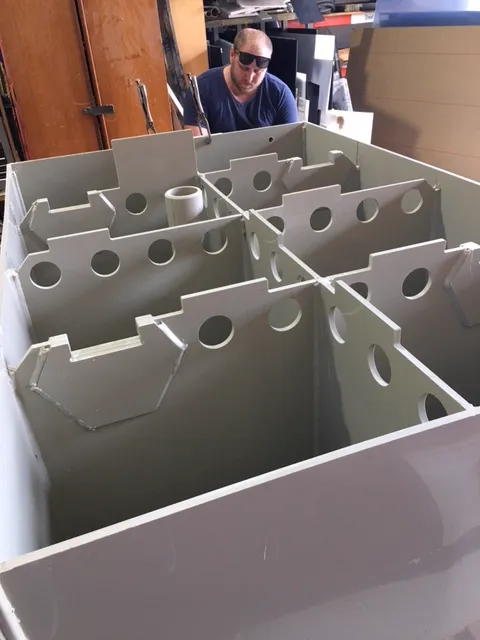
Materials / HDPE
High-Density Polyethylene
Chemical-resistant, UV-stable engineering plastic. Available in sheets, rods & tubes for tanks, pipes, and industrial applications.
-50 to +80°C
Operating range
1-100mm+
Sheet thickness
AS 4020
Drinking water grade
High-Density Polyethylene (HDPE) is a tough, chemical-resistant engineering plastic used across water treatment, mining, agriculture, food processing and marine industries. Australian fabricators specify HDPE when a part has to handle aggressive chemicals, UV exposure and impact without rusting or cracking. It is one of the few thermoplastics that can be welded into watertight tanks the same way steel can be welded, which is why HDPE dominates secondary containment, dosing systems and bulk water storage across Queensland.
Sizes and formats we stock
Our Gold Coast workshop carries HDPE sheet from 1mm signage grade up to 100mm block. The most common formats are 2440 x 1220mm and 3050 x 1525mm sheets in 5mm, 10mm, 12mm, 15mm, 20mm and 25mm thickness. HDPE rod is available from 10mm to 250mm diameter. PE100 pipe and pipe stub fittings are stocked in standard plumbing sizes. We cut everything on CNC routers, so non-standard widths, cutouts and full custom shapes carry no extra setup.
Colours and grades
Natural HDPE (translucent off-white) and black are stocked as standard. Coloured HDPE sheet is available in white, green, blue, red, yellow and grey, mainly for cutting boards , signage and playground use. Only black HDPE is recommended for permanent outdoor exposure because the carbon black additive blocks UV. Marine and food-grade HDPE meet AS 4020 drinking water and FDA food contact standards on request.
HDPE compared to polypropylene and steel
Compared to polypropylene , HDPE is stiffer, more impact-resistant at cold temperatures and easier to weld for large fabrications. Polypropylene wins on resistance to strong acids and on heat resistance (continuous service to around 100°C for PP-H, versus HDPE's 80°C ceiling). For most plumbed tanks under 60°C, HDPE is the safer pick on price and weldability. Compared to mild steel, HDPE will not corrode, weighs roughly one eighth as much and removes the need for linings, paint or galvanising.
Why P&M Plastics for HDPE work
We have been fabricating HDPE on the Gold Coast for more than 35 years, with 200+ commercial clients across South East Queensland and northern New South Wales. Extrusion welders, hot air welders, CNC routers and forming jigs all live in our workshop, so tanks, bunds and pipe assemblies go from sheet to leak-tested unit under one roof. Our 4.7-star Google rating reflects fast quote turnarounds, accurate fabrication and on-time delivery.
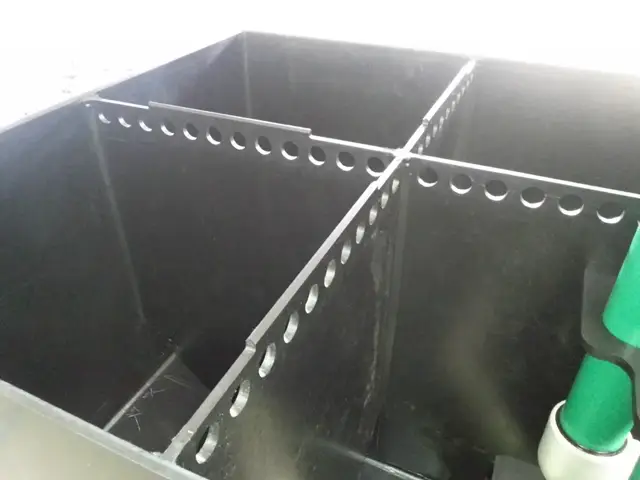
Internal baffles welded inside HDPE tank
Key Properties
Common Applications
Specialty HDPE applications on the Gold Coast
Project Gallery
How We Fabricate HDPE
We fabricate HDPE using CNC routing for precision cutting, hot air welding for sheet joins and seam work, and extrusion welding for tank and bund construction (extrusion welds achieve a short-term welding factor of around 0.8 per DVS 2203-1, with a long-term creep factor near 0.4 per DVS 2203-4). Saw cutting handles flat sheet to size. HDPE machines well on standard tooling, threads cleanly and accepts mechanical fasteners. Bonding with adhesive is possible after flame or corona treatment but welding is preferred for any load-bearing or watertight joint.
Buy HDPE Online
Shop at Perspex Online
Compare Materials
See how HDPE stacks up
Cut to Size Calculator
Get instant pricing online
Related Services
CNC Router Services
Computer-controlled CNC routing for precision plastic cutting, profiling, and engraving.
Plastic Tank Fabrication
Custom HDPE and polypropylene tanks for water, chemical, and industrial storage applications.
Cut to Size Plastics
Plastic sheets, rods, and tubes cut to your exact dimensions from a wide range of materials.
Plastic Welding
Industrial-grade plastic welding for tanks, pipes, bunds, and structural assemblies.
Products made from HDPE
Plastic Tanks
Custom-fabricated HDPE and polypropylene tanks for water, chemical, and industrial storage.
Caravan & RV Water Tanks
Custom fresh, grey and drinking water tanks fabricated to fit your caravan, camper or RV.
Underground Water Tanks
Custom below-ground HDPE and polypropylene water tanks built to save space and store more.
Ute & Truck Water Tanks
Under-tray, water cartage and slip-on water tanks fabricated for utes, trucks and trailers.
Industrial Water Tanks
Custom-fabricated HDPE and polypropylene tanks for industrial process, storage and wash-down.
Chemical Storage Tanks
Polypropylene, PVC and HDPE chemical storage, dosing and bunded tanks built for chemical resistance.
Boat Water Tanks
Custom-fabricated marine-grade HDPE water tanks built to fit your boat's hull exactly. Food-safe, UV-stabilised, and built on the Gold Coast.
Fire Fighting Water Tanks
Static water-supply tanks fabricated in HDPE for rural fire protection and compliance.
Bunds & Containment Systems
Secondary containment bunds and spill trays for environmental compliance.
Custom Fabricated Parts
Bespoke CNC-routed, laser-cut, and welded plastic components to your specs.
Plastic Sheets & Panels
Cut-to-size plastic sheets in HDPE, Acrylic, Polycarbonate, PVC, and more.
Wear Strips & Slide Rails
UHMWPE and nylon wear strips, guide rails, and conveyor liners for heavy industry.
Emergency Vehicle Parts
Custom plastic panels, light covers, and fabricated components for emergency service vehicles.
Cutting Boards
Commercial-grade HDPE cutting boards for butchers, kitchens, and food processing, HACCP colour coded.
Transom Plates
Custom plastic transom plates for outboard motors in HDPE, nylon and UHMWPE. CNC-cut to your measurements at our Gold Coast workshop.
Custom Reptile Enclosures
Custom-built acrylic and polycarbonate reptile enclosures designed for visibility, ventilation, and easy maintenance. Made on the Gold Coast for hobbyists, breeders, and pet shops.
Buy hdpe online
Our sister store Perspex Online sells hdpe cut to size with national delivery.
Frequently Asked Questions
What thickness HDPE should I use for a water tank? +
Wall thickness is driven by tank diameter and fill height, not by capacity alone. We design every welded HDPE tank using the hoop-stress methodology in DVS 2205 (the German PE tank standard most Australian fabricators reference) and the AS/NZS 4766 wall calc framework. As a guide, small fabricated tanks around 1,000L typically run 8mm to 12mm walls; mid-size 2,000L to 5,000L tanks step up to 12mm to 15mm; and large industrial tanks above 10,000L use 20mm to 30mm walls with welded ribs or external bracing. Final thickness depends on liquid density, service temperature and whether the tank is open or closed, so every tank gets an individual wall calc before fabrication.
What chemicals can HDPE resist, and which ones attack it? +
HDPE is resistant to most acids, alkalis, alcohols, salts and aqueous solutions used in industry, including dilute sulphuric, hydrochloric, sodium hydroxide and sodium hypochlorite. It is not suitable for strong oxidising acids (fuming nitric, concentrated sulphuric above 70%), chlorinated solvents or aromatic hydrocarbons such as toluene. Send us the SDS and we will confirm compatibility before quoting.
Can HDPE be welded, and how strong is the weld? +
Yes. HDPE is one of the easiest thermoplastics to weld, using hot air welding with HDPE rod or extrusion welding. Per DVS 2203-1 (the German weld-testing standard) a well-executed extrusion weld reaches a short-term welding factor of around 0.8, meaning about 80 percent of the parent sheet's tensile strength. The long-term creep factor per DVS 2203-4 sits near 0.4, which is the figure we engineer to for tanks, bunds and bulk storage. Our PE welding follows the parameters in DVS 2207-1 and DVS 2207-4.
Is HDPE food grade? +
Food-grade HDPE is available and is widely used for cutting boards, chopping blocks, food processing parts and drinking water tanks. We supply HDPE certified to FDA 21 CFR 177.1520 for food contact and AS 4020 for potable water on request. Always specify food grade at quote time; not all stock sheet is certified.
Can I glue HDPE, or do I need to weld it? +
HDPE is notoriously hard to bond because of its low surface energy. Standard adhesives will not stick reliably without surface preparation. For permanent joints we always recommend welding. If welding is not an option, flame or corona treatment plus a specialist polyolefin primer can give a serviceable bond, but never use it on watertight or load-bearing work.
How does HDPE perform outdoors over time? +
Black HDPE with carbon black additive holds up indefinitely outdoors and is the standard choice for outdoor tanks, agricultural use and infrastructure. Natural and coloured HDPE will chalk slightly and lose some surface gloss after a few years of full sun, though structural performance is largely unaffected. For long-term outdoor exposure, specify a UV-stabilised grade.
What is the difference between HDPE and UHMWPE? +
UHMWPE has a much longer polymer chain, which gives it dramatically better wear resistance and a lower coefficient of friction than standard HDPE. UHMWPE is the right pick for chute liners, hopper liners, conveyor wear strips and parts that slide under load. HDPE remains the right pick for tanks, bunds, pipework and general fabrications because it welds and is much cheaper.
Do you deliver HDPE to Brisbane and the Sunshine Coast? +
Yes. We deliver finished HDPE work and stock sheet from our Yatala workshop across the Gold Coast, Brisbane, Ipswich, Logan, Redlands and the Sunshine Coast. We also freight Queensland-wide and into northern New South Wales for larger orders. Pickup from Yatala is welcome by appointment.
Buy HDPE Online
Shop at Perspex Online
Compare Materials
See how HDPE stacks up
Cut to Size Calculator
Get instant pricing online
Need Advice?
Not sure if HDPE is right for your application? Our materials experts can help.
07 5535 7544Accepted File Formats
Cut to Size Calculator
Get instant pricing for plastic sheets cut to your exact dimensions. Choose your material, thickness, and measurements; order online with nationwide delivery.
Related Materials
More from Engineering Plastics
Polypropylene (PP)
Lightweight, food-grade plastic in sheets, rods & tubes for water treatment, chemical processing, and fabrication.
Polyvinyl Chloride (PVC)
Versatile, cost-effective plastic in sheets, rods & tubes for piping, ducting, and chemical containment.
Nylon (Polyamide)
High-strength engineering plastic in sheets, rods & tubes for gears, bearings, and mechanical components.
Polycarbonate (PC)
Impact-resistant transparent plastic in sheets, rods & tubes for machine guards, glazing, and safety barriers.
Ultra-High Molecular Weight Polyethylene
Extreme wear-resistant plastic in sheets & rods for conveyor guides, chute liners, and mining components.
Acetal (Delrin / POM)
Low-friction engineering plastic in sheets & rods for precision mechanical parts, gears, and bearings.
PETG (Polyethylene Terephthalate Glycol)
Tough, clear thermoplastic in sheets for displays, machine guards, and food-contact applications.
PTFE (Teflon)
Extreme temperature and chemical resistant plastic in sheets, rods & tubes for seals, gaskets, and bearings.
Other Materials
Acrylic (Perspex / PMMA)
Crystal-clear optical-grade plastic in sheets, rods & tubes for displays, signage, and protective barriers.
High Impact Polystyrene (HIPS)
Cost-effective, easy-to-form plastic sheets for signage, packaging, and vacuum forming.
Foam PVC (Foamex)
Lightweight, rigid foam board for signage, displays, and interior cladding.
Corflute (Corrugated Polypropylene)
Lightweight, fluted plastic sheet for signage, packaging, and temporary protection.
High Impact Acrylic
Modified acrylic with enhanced impact resistance for safety glazing and protective applications.
Aluminium Composite Panel (ACP)
Aluminium-faced composite sheet for architectural cladding, signage, and facades.
Lisa M.
3 months ago
“Amazing work on our acrylic display cases for the museum exhibition. Crystal clear, no imperfections. The team went above and beyond.”
David R.
2 months ago
“Good quality laser cutting work. The acrylic edges came out beautifully polished. Will definitely use again for our signage projects.”
Karen W.
4 months ago
“Had polycarbonate machine guards made for our factory. Perfect fit, great finish, and the team was really helpful with the design.”
Michael T.
2 months ago
“Excellent service and quality work. Had some custom acrylic display cases made and they turned out perfect. Fast turnaround too.”
Sarah L.
3 months ago
“P&M Plastics fabricated custom HDPE tanks for our water treatment plant. Professional team, great communication, and delivered on time.”
James B.
1 month ago
“We use P&M for all our CNC routing needs. Consistent quality and they really understand engineering plastics. Highly recommended.”
Ready to Start Your Project?
Get an accurate quote within 24 hours. Provide your specs, drawings, or dimensions and our fabrication team will respond fast.