
Materials / Polycarbonate
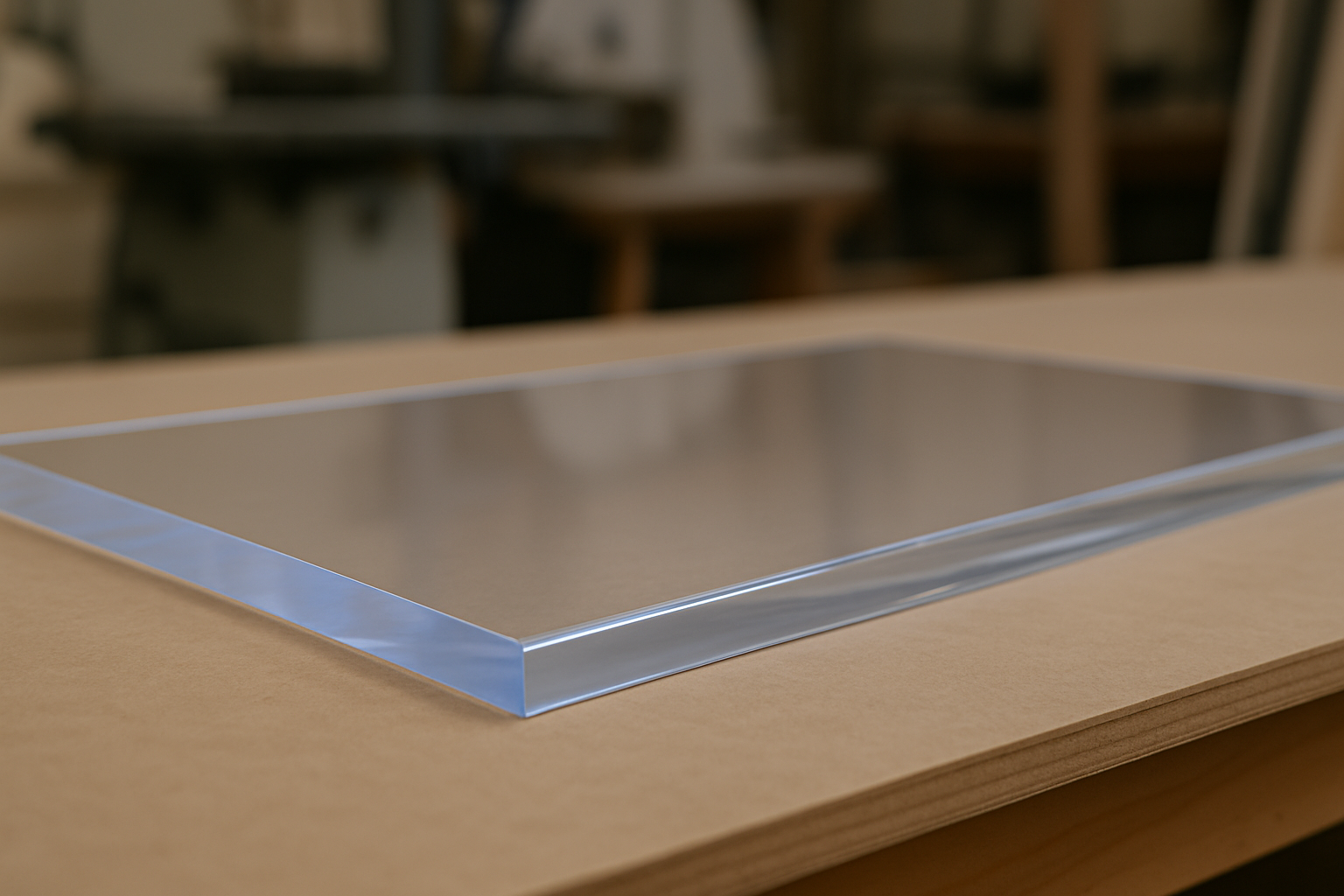
Polycarbonate (PC)
Impact-resistant transparent plastic in sheets, rods & tubes for machine guards, glazing, and safety barriers.
250x glass
Impact strength
-40 to +120°C
Operating range
2-25mm
Sheet thickness
Polycarbonate (PC) is the high-impact engineering plastic of choice for machine guards, ballistic glazing, riot shields and skylights. By modern notched Izod testing (ASTM D256), solid polycarbonate carries roughly 100 times the impact strength of annealed glass and around 30 times that of cast acrylic, while staying optically clear. P&M Plastics fabricates polycarbonate for machine guarding, security glazing, sneeze guards in high-impact areas, skylight glazing and twin-wall greenhouse panels.
Sizes and formats we stock
Solid polycarbonate sheet is stocked in 2mm, 3mm, 4mm, 5mm, 6mm, 8mm, 10mm, 12mm, 15mm, 20mm and 25mm in standard 2440 x 1220mm and 3050 x 2030mm sizes. Twin-wall and multi-wall polycarbonate sheet (4mm to 16mm) is held for greenhouse and skylight glazing. Polycarbonate rod is available from 10mm to 100mm diameter for machined parts.
Colours and grades
Clear is the standard. Solar bronze, opal, smoked grey and tinted grades are stocked for solar glazing and architectural use. UV-resistant exterior grades are mandatory for any polycarbonate that lives outside, since uncoated polycarbonate will yellow under sustained UV. Abrasion-resistant (AR) hard-coated grades are stocked for machine guarding and any panel that will be cleaned often.
Polycarbonate compared to acrylic
Polycarbonate beats acrylic by a wide margin on raw impact resistance, which is why it is the default for machine guards, security glazing and high-impact public-area screens. Acrylic is stiffer, polishes to a better edge, laser-cuts cleanly and lasts longer in full sun, so it remains the right pick for retail display, signage and indoor screens. For curved formed parts we usually use acrylic; for flat impact-loaded panels we use polycarbonate.
Why P&M Plastics for polycarbonate work
We CNC route, cold-bend and mechanically fix polycarbonate panels for machine guards, factory enclosures and architectural skylights. Polycarbonate cannot be solvent-cemented the way acrylic can, so all structural joins are mechanical (rivets, screws, captive bolts) with sealant beads. Our shop carries the right hard-coated and UV-resistant grades so the finished panel performs in service.
Key Properties
Common Applications
Specialty Polycarbonate applications on the Gold Coast
Project Gallery
How We Fabricate Polycarbonate
We fabricate polycarbonate using CNC routing for precision cutting and saw cutting for sheet to size. Polycarbonate drills, taps and accepts mechanical fasteners well. It cannot be solvent-cemented (Tensol will craze polycarbonate), so all structural assembly uses screws, rivets or captive bolts with sealants. Polycarbonate is hygroscopic and must be dried before thermoforming or laser cutting.
Buy Polycarbonate Online
Shop at Perspex Online
Compare Materials
See how Polycarbonate stacks up
Cut to Size Calculator
Get instant pricing online
Related Services
CNC Router Services
Computer-controlled CNC routing for precision plastic cutting, profiling, and engraving.
Custom Plastic Fabrication
Full-service plastic fabrication: designed, cut, welded, and assembled to your exact specifications.
Cut to Size Plastics
Plastic sheets, rods, and tubes cut to your exact dimensions from a wide range of materials.
Products made from Polycarbonate
Machine Guards & Safety Barriers
Polycarbonate and acrylic guards engineered for workplace safety compliance.
Custom Fabricated Parts
Bespoke CNC-routed, laser-cut, and welded plastic components to your specs.
Industrial Signage & Labels
Laser engraved industrial signage, safety labels, control panel tags, and identification plates.
Sneeze Guards
Clear acrylic and polycarbonate protective screens for food service and retail counters.
Plastic Sheets & Panels
Cut-to-size plastic sheets in HDPE, Acrylic, Polycarbonate, PVC, and more.
Skylight Covers & Diffusers
Replacement skylight covers and prismatic light diffuser panels for commercial and residential.
Dog & Cat Doors
Clear acrylic and polycarbonate pet doors for glass, timber, and screen doors.
Emergency Vehicle Parts
Custom plastic panels, light covers, and fabricated components for emergency service vehicles.
Polycarbonate Windscreens
Custom polycarbonate windscreens and cab screens for excavators, forestry machines, boats, marine vessels, and heavy equipment. Impact-resistant, optically clear, CNC-fabricated on the Gold Coast.
Custom Reptile Enclosures
Custom-built acrylic and polycarbonate reptile enclosures designed for visibility, ventilation, and easy maintenance. Made on the Gold Coast for hobbyists, breeders, and pet shops.
Buy polycarbonate online
Our sister store Perspex Online sells polycarbonate cut to size with national delivery.
Frequently Asked Questions
How much stronger than glass is polycarbonate really? +
The widely quoted '250 times' figure comes from early-1970s GE/Lexan ball-drop comparisons against thin annealed glass and is not a standard test result. By modern notched Izod testing (ASTM D256), solid polycarbonate sits around 12 to 18 ft-lb/in versus a fraction of that for annealed glass, which works out closer to a 60 to 100 times difference. It is still dramatically tougher than glass and around 30 times the notched Izod impact of cast acrylic, which is why polycarbonate is the default for machine guards, bullet-resistant glazing and riot shields. Polycarbonate scratches more easily than acrylic, so for high-cleaning environments we specify hard-coated grades.
Can polycarbonate be used outdoors? +
Only UV-resistant grades. Uncoated polycarbonate will yellow and become brittle after a few years of full Australian sun. UV-resistant exterior grades have a co-extruded UV protective layer that blocks degradation and carries warranties of 10 years or more. For outdoor signage we usually recommend acrylic instead, which holds up to UV better than even UV-coated polycarbonate.
Can I glue polycarbonate? +
Polycarbonate is sensitive to most acrylic solvents (Tensol 12 will craze and crack it) and to many common adhesives. Specialist polyurethane and silicone adhesives bond polycarbonate, but for structural joins we use mechanical fasteners (screws, rivets, captive bolts) with sealant beads. For ballistic and security work, all joints are mechanical.
How do you stop polycarbonate from scratching? +
Specify a hard-coated abrasion-resistant grade (often labelled AR or HC). The factory coating roughly triples scratch resistance and is essential for any panel that will be wiped down often, like sneeze guards and machine windows. Without the coating, polycarbonate scratches more easily than acrylic.
What thickness do I need for a machine guard? +
Most machine guards are 6mm to 12mm polycarbonate depending on the impact load and panel size. For impact testing to EN 1837 or AS 4024 we will size the panel to the energy of the worst-case projectile (such as a snapped end mill or thrown fastener). Send us the machine type and we will spec the right thickness.
Can polycarbonate be bent or formed? +
Yes. Polycarbonate cold-bends to large radii without heat and thermoforms over moulds at around 180°C, which is why it is used for curved security screens, full-face shields and curved machine guards. It must be dried in an oven first (it is hygroscopic), otherwise bubbles appear during forming.
Is polycarbonate flame retardant? +
Yes. Standard polycarbonate carries a UL 94 V-2 flame rating; higher V-0 grades are available for electrical enclosures and rail applications. It is self-extinguishing and produces low smoke compared to acrylic.
Buy Polycarbonate Online
Shop at Perspex Online
Compare Materials
See how Polycarbonate stacks up
Cut to Size Calculator
Get instant pricing online
Need Advice?
Not sure if Polycarbonate is right for your application? Our materials experts can help.
07 5535 7544Accepted File Formats
Cut to Size Calculator
Get instant pricing for plastic sheets cut to your exact dimensions. Choose your material, thickness, and measurements; order online with nationwide delivery.
Related Materials
More from Engineering Plastics
High-Density Polyethylene
Chemical-resistant, UV-stable engineering plastic. Available in sheets, rods & tubes for tanks, pipes, and industrial applications.
Polypropylene (PP)
Lightweight, food-grade plastic in sheets, rods & tubes for water treatment, chemical processing, and fabrication.
Polyvinyl Chloride (PVC)
Versatile, cost-effective plastic in sheets, rods & tubes for piping, ducting, and chemical containment.
Nylon (Polyamide)
High-strength engineering plastic in sheets, rods & tubes for gears, bearings, and mechanical components.
Ultra-High Molecular Weight Polyethylene
Extreme wear-resistant plastic in sheets & rods for conveyor guides, chute liners, and mining components.
Acetal (Delrin / POM)
Low-friction engineering plastic in sheets & rods for precision mechanical parts, gears, and bearings.
PETG (Polyethylene Terephthalate Glycol)
Tough, clear thermoplastic in sheets for displays, machine guards, and food-contact applications.
PTFE (Teflon)
Extreme temperature and chemical resistant plastic in sheets, rods & tubes for seals, gaskets, and bearings.
Other Materials
Acrylic (Perspex / PMMA)
Crystal-clear optical-grade plastic in sheets, rods & tubes for displays, signage, and protective barriers.
High Impact Polystyrene (HIPS)
Cost-effective, easy-to-form plastic sheets for signage, packaging, and vacuum forming.
Foam PVC (Foamex)
Lightweight, rigid foam board for signage, displays, and interior cladding.
Corflute (Corrugated Polypropylene)
Lightweight, fluted plastic sheet for signage, packaging, and temporary protection.
High Impact Acrylic
Modified acrylic with enhanced impact resistance for safety glazing and protective applications.
Aluminium Composite Panel (ACP)
Aluminium-faced composite sheet for architectural cladding, signage, and facades.
Lisa M.
3 months ago
“Amazing work on our acrylic display cases for the museum exhibition. Crystal clear, no imperfections. The team went above and beyond.”
David R.
2 months ago
“Good quality laser cutting work. The acrylic edges came out beautifully polished. Will definitely use again for our signage projects.”
Karen W.
4 months ago
“Had polycarbonate machine guards made for our factory. Perfect fit, great finish, and the team was really helpful with the design.”
Michael T.
2 months ago
“Excellent service and quality work. Had some custom acrylic display cases made and they turned out perfect. Fast turnaround too.”
Sarah L.
3 months ago
“P&M Plastics fabricated custom HDPE tanks for our water treatment plant. Professional team, great communication, and delivered on time.”
James B.
1 month ago
“We use P&M for all our CNC routing needs. Consistent quality and they really understand engineering plastics. Highly recommended.”
Ready to Start Your Project?
Get an accurate quote within 24 hours. Provide your specs, drawings, or dimensions and our fabrication team will respond fast.