Materials / MDF
Medium-Density Fibreboard (MDF)
Smooth, uniform engineered board for CNC routing, laser cutting, signage, joinery, and painted finishes.
3-25mm
Sheet thickness
2400x1200mm
Standard sheet
E1 / E0
Formaldehyde grades
Medium-Density Fibreboard (MDF) is the workhorse engineered timber panel for cabinetmaking, shop fitting, signage substrate, display construction and CNC-routed letterwork. It is smooth, dense, dimensionally uniform and machines to a clean edge that paints and laminates well. P&M Plastics CNC-routes MDF to client artwork files for sign makers, shop fit-out contractors and exhibition builders across the Gold Coast and Brisbane .
Sizes and formats we stock
Standard MDF is stocked in 3mm, 6mm, 9mm, 12mm, 16mm, 18mm and 25mm in standard 2400 x 1200mm sheet. The 12mm and 18mm grades are the workhorses for cabinetry and signage; thinner grades (3mm and 6mm) are used for backings, drawer bottoms and laminated panels. We also stock moisture-resistant MR-MDF for kitchen and bathroom applications.
Colours and grades
Natural MDF (light tan) is the standard. Coloured, dyed-through MDF such as Valchromat is available on indent in colours including black, white, grey, blue and red for high-end signage and decorative panels; ask us for current colours and lead time. Moisture-resistant MR-MDF (typically green-tinted) is stocked for splashbacks and bathroom cabinetry. Fire-rated FR-MDF is available on order for compliant commercial work.
Plain (standard) MDF vs coloured (Valchromat) MDF
Standard MDF and coloured, dyed-through MDF such as Valchromat look similar on the face but behave very differently once you cut into them. The difference comes down to one thing: plain MDF is coloured only on the surface, while coloured MDF is dyed all the way through. Here is how they compare.
- Colour depth: plain MDF has a natural brown-tan core with colour only where you paint or laminate it; coloured MDF is dyed right through, so the colour is the board itself.
- Cut and routed edges: plain MDF shows the raw core on every cut edge and needs edge-banding, filling or paint to finish; coloured MDF shows the same colour on the edge as the face, finished straight off the saw.
- Machining and engraving: cutting into plain MDF exposes the pale core; routing or engraving coloured MDF reveals more of the same colour, which is why it suits V-carved, engraved and routed detail.
- Binder and moisture: standard MDF uses a standard binder with low moisture resistance, MR grades aside; many coloured, dyed-through boards use a modified, more moisture-tolerant binder, though neither is waterproof.
- Finish and feel: plain MDF is smooth and paint-ready; coloured MDF has a slightly matte, through-colour surface that also takes oil or wax well.
- Typical use: plain MDF suits painted or laminated cabinetry, substrate, shop fitting and jigs; coloured MDF suits exposed-edge furniture, retail and display, signage and decorative or acoustic panels.
- Relative cost: plain MDF is the economical everyday board; coloured MDF is a premium product, typically two to four times the price.
When to use plain vs coloured MDF
- Choose plain (standard) MDF when the panel will be painted, laminated or hidden, or when budget matters and the cut edges will not be on show. It is the right board for the large majority of cabinetry and signage substrate work.
- Choose coloured (Valchromat) MDF when cut, routed or engraved edges are exposed and you want them finished without edge-banding or paint, such as retail displays, designer furniture, signage returns and acoustic slat panels. This is where we CNC-rout coloured MDF so the machined edge reads as a finished, coloured detail.
Whichever you choose, remember that neither plain nor coloured MDF is waterproof or structural, and neither is suitable for outdoor use. Match the grade to the job, and seal or finish any edge that will see moisture.
MDF compared to plywood
MDF is denser and more dimensionally uniform than plywood , has no grain to chase and machines to a flawless edge ready for paint or laminate. Plywood is lighter, stiffer per kilogram and far stronger across the panel, which is why structural shelving, jigs and load-bearing work goes in plywood. For signage, cabinetry doors, drawer fronts and decorative panels, MDF is the right pick. For shelving, structural builds and any panel that needs to take real load, choose plywood.
Why P&M Plastics for MDF work
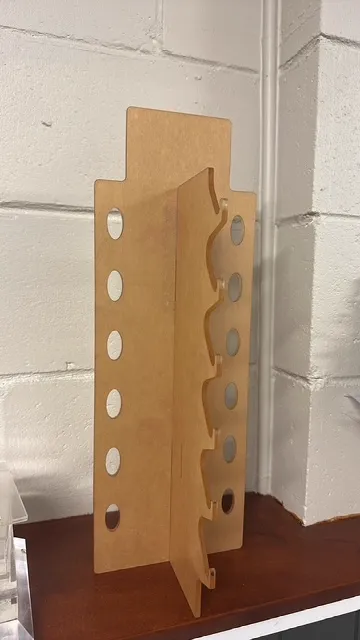
We CNC-route MDF to client artwork files for dimensional signage, free-standing letters, shop fit-out panels, exhibition stands and bespoke cabinet doors. Our CNC produces machined edges ready for paint or laminate; we also V-groove for folded signage and edge-profile for finished decorative work. For shop-fit clients we run high-volume cabinet door batches with consistent edge quality.
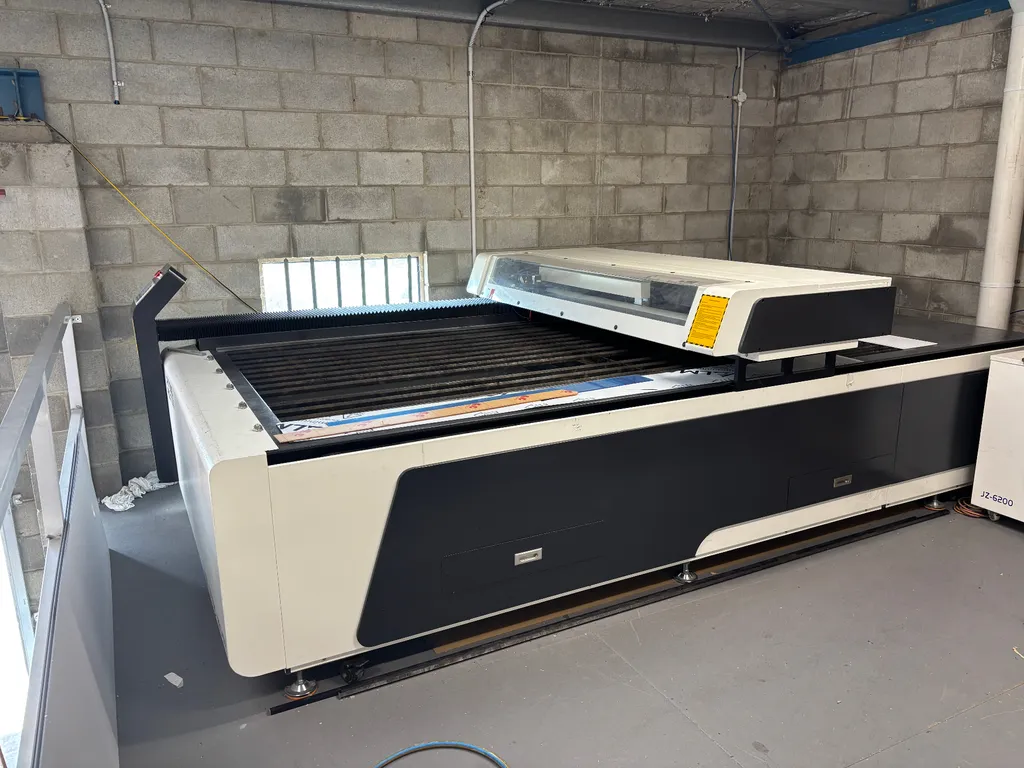
CNC router machining MDF panel
Key Properties
Common Applications
Project Gallery
How We Fabricate MDF
We fabricate MDF using CNC routing for precision cutting and edge profiling, panel saws for high-volume straight cuts, edge banding for finished cabinet edges, and V-grooving for folded signage. MDF accepts paint, laminate, vinyl and adhesive without surface preparation beyond a light sand. For load-bearing fixings, pre-drill and use coarse-thread screws; raw MDF will not hold standard wood screws under load.
Related Services
CNC Router Services
Computer-controlled CNC routing for precision plastic cutting, profiling, and engraving.
Laser Cutting Services
Precision laser cutting for intricate shapes, clean edges, and polished finishes.
Laser Engraving & Etching
Precision 2D and 3D laser engraving and etching for signage, branding, industrial marking, and decorative applications.
MDF & Plywood Machining
CNC routing and laser cutting of MDF and plywood for signage, furniture, joinery, and custom components.
Buy mdf online
Our sister store Perspex Online sells mdf cut to size with national delivery.
Frequently Asked Questions
Can MDF be used outdoors? +
No. Standard MDF will swell, delaminate and rot within months of outdoor exposure because it absorbs moisture readily. For exterior signage and panels we use Foam PVC, ACP or marine plywood instead. Moisture-resistant MR-MDF tolerates splash and humidity (bathrooms, kitchens) but is still not suitable for direct outdoor use.
What is the difference between standard MDF, MR-MDF and FR-MDF? +
Standard MDF is the workhorse for interior cabinetry and signage. MR-MDF (moisture-resistant, usually green-tinted) tolerates splash and humidity for bathroom and kitchen work. FR-MDF (fire-retardant) meets AS 1530 fire ratings for commercial fit-outs. Coloured grades (Valchromat) are dyed through the board for high-end decorative work.
Can MDF be CNC-cut to a logo or letter shape? +
Yes. CNC routing cuts MDF to any 2D shape from a vector file (DXF, DWG, AI, SVG, PDF). The machined edge is ready for paint or laminate with no secondary preparation. For 3D dimensional work we cut multiple layers and stack-bond for built-up letters and signage.
How do you finish MDF? +
Cut edges should be sanded lightly and sealed with primer or PVA before topcoat to prevent the edge from soaking in paint unevenly. Two coats of acrylic primer plus topcoat give a furniture-quality finish. For high-end work we use lacquer or two-pack PU for hardwearing surfaces.
Can MDF be screwed? +
Yes, with pre-drilling. Raw MDF will not hold standard wood screws under load because the edges will split. For face-fixing into a panel, standard wood screws work fine. For edge fixing or load-bearing work, use coarse-thread MDF screws or specialist MDF anchor inserts.
Is MDF safe to cut? +
MDF generates fine dust when cut that should not be inhaled. Always cut with dust extraction or a dust mask rated for fine particulate. Modern MDF is manufactured to E1 (low formaldehyde) or E0 (ultra-low formaldehyde) standards, which is safe for installed indoor use, but airborne dust during cutting still needs proper PPE.
What thickness MDF do I need? +
Cabinet doors and drawer fronts typically use 16mm or 18mm. Backings and drawer bottoms use 3mm or 6mm. Dimensional signage uses 12mm to 25mm depending on letter size. Shelving is usually 18mm for short spans and 25mm for spans over 600mm.
What is the difference between plain MDF and coloured (Valchromat) MDF? +
Plain MDF has a natural brown-tan core and is coloured only where you paint or laminate it, so every cut edge shows the raw core. Coloured MDF such as Valchromat is dyed right through the board, so cut, routed and engraved edges show the same colour as the face and are finished straight off the saw. Plain MDF suits painted and laminated work; coloured MDF suits exposed-edge, decorative and signage work.
Is coloured MDF worth the extra cost? +
Coloured, dyed-through MDF typically costs two to four times as much as standard MDF, so it earns its place only where cut or routed edges are on show and you want them finished without edge-banding or paint. For painted, laminated or hidden panels, standard MDF is the more economical choice. It is available on indent, so ask us for current colours, thicknesses and lead time.
Need Advice?
Not sure if MDF is right for your application? Our materials experts can help.
07 5535 7544Accepted File Formats
Cut to Size Calculator
Get instant pricing for plastic sheets cut to your exact dimensions. Choose your material, thickness, and measurements; order online with nationwide delivery.
Related Materials
More from Timber & Board
Other Materials
High-Density Polyethylene
Chemical-resistant, UV-stable engineering plastic. Available in sheets, rods & tubes for tanks, pipes, and industrial applications.
Polypropylene (PP)
Lightweight, food-grade plastic in sheets, rods & tubes for water treatment, chemical processing, and fabrication.
Acrylic (Perspex / PMMA)
Crystal-clear optical-grade plastic in sheets, rods & tubes for displays, signage, and protective barriers.
Polyvinyl Chloride (PVC)
Versatile, cost-effective plastic in sheets, rods & tubes for piping, ducting, and chemical containment.
Nylon (Polyamide)
High-strength engineering plastic in sheets, rods & tubes for gears, bearings, and mechanical components.
Polycarbonate (PC)
Impact-resistant transparent plastic in sheets, rods & tubes for machine guards, glazing, and safety barriers.
Lisa M.
3 months ago
“Amazing work on our acrylic display cases for the museum exhibition. Crystal clear, no imperfections. The team went above and beyond.”
David R.
2 months ago
“Good quality laser cutting work. The acrylic edges came out beautifully polished. Will definitely use again for our signage projects.”
Karen W.
4 months ago
“Had polycarbonate machine guards made for our factory. Perfect fit, great finish, and the team was really helpful with the design.”
Michael T.
2 months ago
“Excellent service and quality work. Had some custom acrylic display cases made and they turned out perfect. Fast turnaround too.”
Sarah L.
3 months ago
“P&M Plastics fabricated custom HDPE tanks for our water treatment plant. Professional team, great communication, and delivered on time.”
James B.
1 month ago
“We use P&M for all our CNC routing needs. Consistent quality and they really understand engineering plastics. Highly recommended.”
Ready to Start Your Project?
Get an accurate quote within 24 hours. Provide your specs, drawings, or dimensions and our fabrication team will respond fast.