
Materials / PTFE
PTFE (Teflon)
Extreme temperature and chemical resistant plastic in sheets, rods & tubes for seals, gaskets, and bearings.
-200 to +260°C
Operating range
0.04-0.10
Lowest friction
1-25mm
Sheet thickness
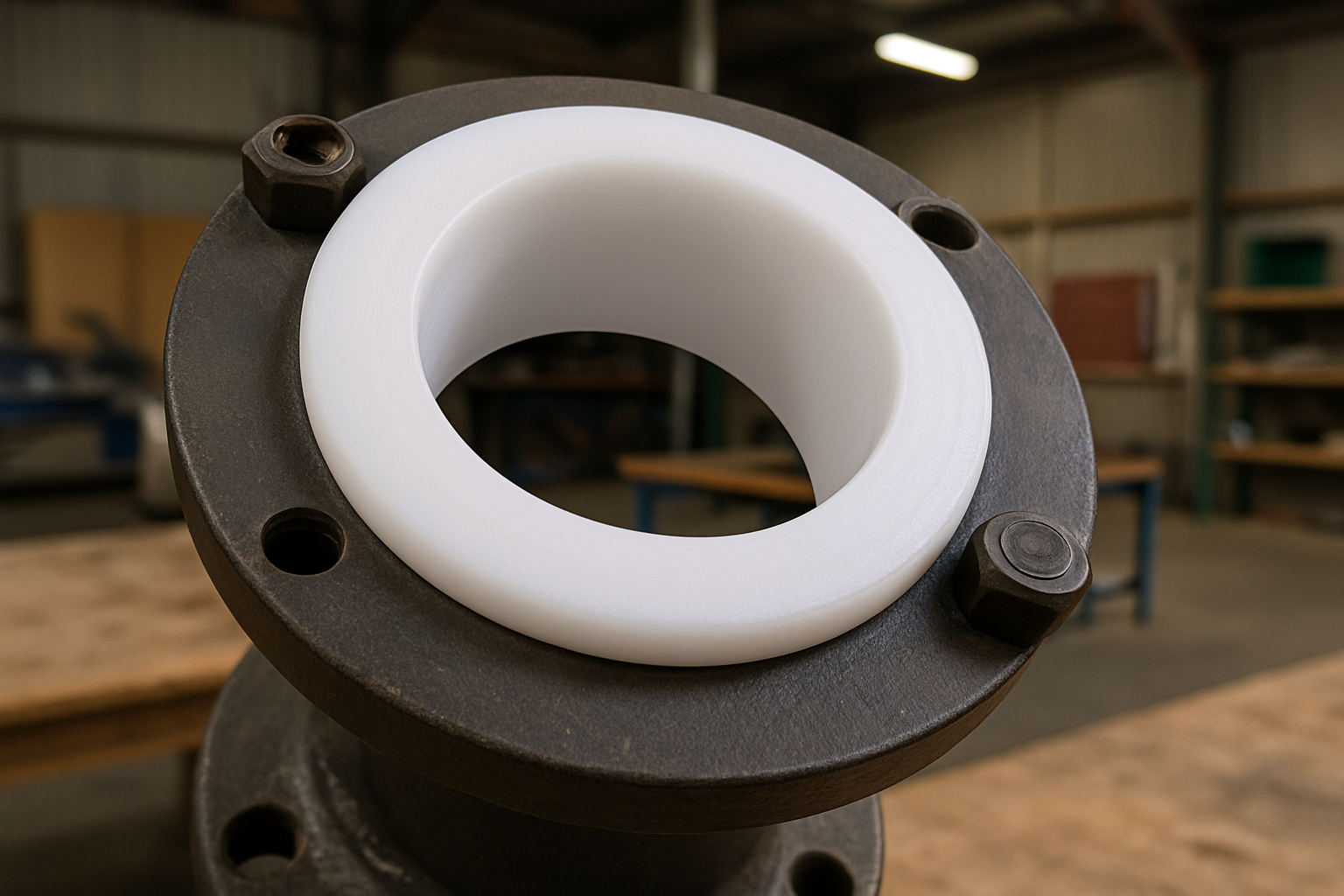
PTFE (polytetrafluoroethylene, commonly known by the trade name Teflon) is the chemical-resistance and high-temperature champion of the engineering plastics family. It resists virtually every industrial chemical, runs from cryogenic temperatures up to 260°C, and has the lowest coefficient of friction of any solid material. P&M Plastics machines PTFE for chemical processing seals, valve seats, gaskets, electrical insulators and high-temperature slide bearings.
Sizes and formats we stock
PTFE sheet is stocked in 1mm, 1.5mm, 2mm, 3mm, 4mm, 5mm, 6mm, 8mm, 10mm, 15mm, 20mm and 25mm in skived (rolled from sintered billet) and moulded grades. PTFE rod runs from 5mm to 200mm diameter. Filled PTFE grades (glass-filled, carbon-filled, bronze-filled) are stocked for high-load and high-wear applications.
Colours and grades
Natural (white) is the standard. Filled grades carry a colour cast: glass-filled PTFE is off-white, carbon-filled is black, bronze-filled is grey. Premium grades include conductive PTFE for ESD applications, ePTFE (expanded PTFE) for high-compression gaskets, and pigmented food-grade PTFE for tank linings and food processing equipment.
PTFE compared to PEEK and acetal
PTFE wins on chemical resistance, temperature range and friction; almost nothing attacks it and nothing beats it for low-friction slide service. The trade-off is that PTFE creeps badly under load (cold flow) and has only modest tensile strength. PEEK holds its strength to higher temperatures and resists creep, but costs many times more and does not match PTFE's chemical resistance. Acetal is stiffer and cheaper, but loses to PTFE on chemicals, temperature and friction. For chemical gaskets and high-temperature slide service, PTFE is the right call.
Why P&M Plastics for PTFE work
We machine PTFE on CNC mills and lathes for chemical processing, mining, food processing and electrical clients across Queensland. PTFE is one of the harder plastics to machine cleanly because it deforms under tool pressure; we run sharp tooling, slow feeds and the right rake angle to leave parts within drawing tolerance.
Key Properties
Common Applications
Project Gallery
How We Fabricate PTFE
We machine PTFE on CNC mills and lathes with sharp, polished tooling to keep edges clean and tolerances tight. PTFE is not weldable in the same way as polyolefins; for assembly, mechanical fasteners or PTFE-rated bonding (with chemical etching to break the non-stick surface) are used. PTFE accepts machining of fine threads, but the threads should not be torqued the way they would be in metal because of cold flow.
Buy PTFE Online
Shop at Perspex Online
Compare Materials
See how PTFE stacks up
Cut to Size Calculator
Get instant pricing online
Related Services
CNC Router Services
Computer-controlled CNC routing for precision plastic cutting, profiling, and engraving.
Custom Plastic Fabrication
Full-service plastic fabrication: designed, cut, welded, and assembled to your exact specifications.
Cut to Size Plastics
Plastic sheets, rods, and tubes cut to your exact dimensions from a wide range of materials.
Buy ptfe online
Our sister store Perspex Online sells ptfe cut to size with national delivery.
Frequently Asked Questions
What chemicals attack PTFE? +
Virtually none. PTFE resists every industrial acid, alkali, solvent, oxidiser and most reactive gases at room temperature, and almost all of them at elevated temperatures too. The few materials that attack PTFE are molten alkali metals (sodium, potassium), elemental fluorine at high temperature, and some chlorine trifluoride compounds. For all practical industrial chemistry, PTFE is inert.
What does cold flow mean for PTFE? +
Under sustained compressive load, unfilled PTFE will slowly deform (creep) over time, which can loosen gaskets and dimensional parts. Filled grades (glass-filled, carbon-filled, bronze-filled) reduce cold flow significantly and are the right pick for any load-bearing PTFE part. For gaskets, ePTFE (expanded PTFE) carries this same benefit while keeping seal compliance.
Is PTFE food-grade? +
Yes. Food-grade PTFE certified to FDA 21 CFR 177.1550 is widely used for food processing seals, chute liners and non-stick conveyor belts. Pigmented food-grade PTFE is also available for visual food contact (blue is common for food-industry traceability).
Can PTFE be glued? +
Standard adhesives will not stick to PTFE because of its non-stick surface. For bonded assemblies the PTFE surface must first be chemically etched with sodium-naphthalene or plasma-treated to create a chemically active surface; etched PTFE then bonds with epoxy or polyurethane adhesives. For most assembly work we recommend mechanical fasteners instead.
What temperature can PTFE hold? +
PTFE has a continuous service temperature of -200°C up to +260°C, which is the widest range of any common plastic. Short-term peaks to 280°C are tolerated. Above this PTFE begins to decompose and should not be used.
Can PTFE be welded? +
PTFE cannot be welded the way polyolefins can; the polymer chain does not flow at melt temperature. For joining PTFE we use mechanical fasteners, etch-and-bond, or for some applications PTFE sheet can be sintered together at high temperature in an oven (specialist process).
Why is PTFE so expensive compared to other plastics? +
The polymer is more expensive to manufacture than polyolefins (multiple polymerisation steps under fluorine) and the resin density is roughly double, which means more weight per sheet at the same dimensions. PTFE is also harder to machine, so the part cost is higher per piece. For chemical and temperature service where PTFE is the only material that works, the cost is justified.
Buy PTFE Online
Shop at Perspex Online
Compare Materials
See how PTFE stacks up
Cut to Size Calculator
Get instant pricing online
Need Advice?
Not sure if PTFE is right for your application? Our materials experts can help.
07 5535 7544Accepted File Formats
Cut to Size Calculator
Get instant pricing for plastic sheets cut to your exact dimensions. Choose your material, thickness, and measurements; order online with nationwide delivery.
Related Materials
More from Engineering Plastics
High-Density Polyethylene
Chemical-resistant, UV-stable engineering plastic. Available in sheets, rods & tubes for tanks, pipes, and industrial applications.
Polypropylene (PP)
Lightweight, food-grade plastic in sheets, rods & tubes for water treatment, chemical processing, and fabrication.
Polyvinyl Chloride (PVC)
Versatile, cost-effective plastic in sheets, rods & tubes for piping, ducting, and chemical containment.
Nylon (Polyamide)
High-strength engineering plastic in sheets, rods & tubes for gears, bearings, and mechanical components.
Polycarbonate (PC)
Impact-resistant transparent plastic in sheets, rods & tubes for machine guards, glazing, and safety barriers.
Ultra-High Molecular Weight Polyethylene
Extreme wear-resistant plastic in sheets & rods for conveyor guides, chute liners, and mining components.
Acetal (Delrin / POM)
Low-friction engineering plastic in sheets & rods for precision mechanical parts, gears, and bearings.
PETG (Polyethylene Terephthalate Glycol)
Tough, clear thermoplastic in sheets for displays, machine guards, and food-contact applications.
Other Materials
Acrylic (Perspex / PMMA)
Crystal-clear optical-grade plastic in sheets, rods & tubes for displays, signage, and protective barriers.
High Impact Polystyrene (HIPS)
Cost-effective, easy-to-form plastic sheets for signage, packaging, and vacuum forming.
Foam PVC (Foamex)
Lightweight, rigid foam board for signage, displays, and interior cladding.
Corflute (Corrugated Polypropylene)
Lightweight, fluted plastic sheet for signage, packaging, and temporary protection.
High Impact Acrylic
Modified acrylic with enhanced impact resistance for safety glazing and protective applications.
Aluminium Composite Panel (ACP)
Aluminium-faced composite sheet for architectural cladding, signage, and facades.
Lisa M.
3 months ago
“Amazing work on our acrylic display cases for the museum exhibition. Crystal clear, no imperfections. The team went above and beyond.”
David R.
2 months ago
“Good quality laser cutting work. The acrylic edges came out beautifully polished. Will definitely use again for our signage projects.”
Karen W.
4 months ago
“Had polycarbonate machine guards made for our factory. Perfect fit, great finish, and the team was really helpful with the design.”
Michael T.
2 months ago
“Excellent service and quality work. Had some custom acrylic display cases made and they turned out perfect. Fast turnaround too.”
Sarah L.
3 months ago
“P&M Plastics fabricated custom HDPE tanks for our water treatment plant. Professional team, great communication, and delivered on time.”
James B.
1 month ago
“We use P&M for all our CNC routing needs. Consistent quality and they really understand engineering plastics. Highly recommended.”
Ready to Start Your Project?
Get an accurate quote within 24 hours. Provide your specs, drawings, or dimensions and our fabrication team will respond fast.